The A350-1000ULR Just Had Its Maiden Flight. Nine Years Later, It's Finally Happening.
Airbus' ultra-long-range A350 took to the skies today for the first time — 22-hour non-stop flights are now a matter of when, not if. Meanwhile, Boeing's 777X is still waiting for the FAA to call.
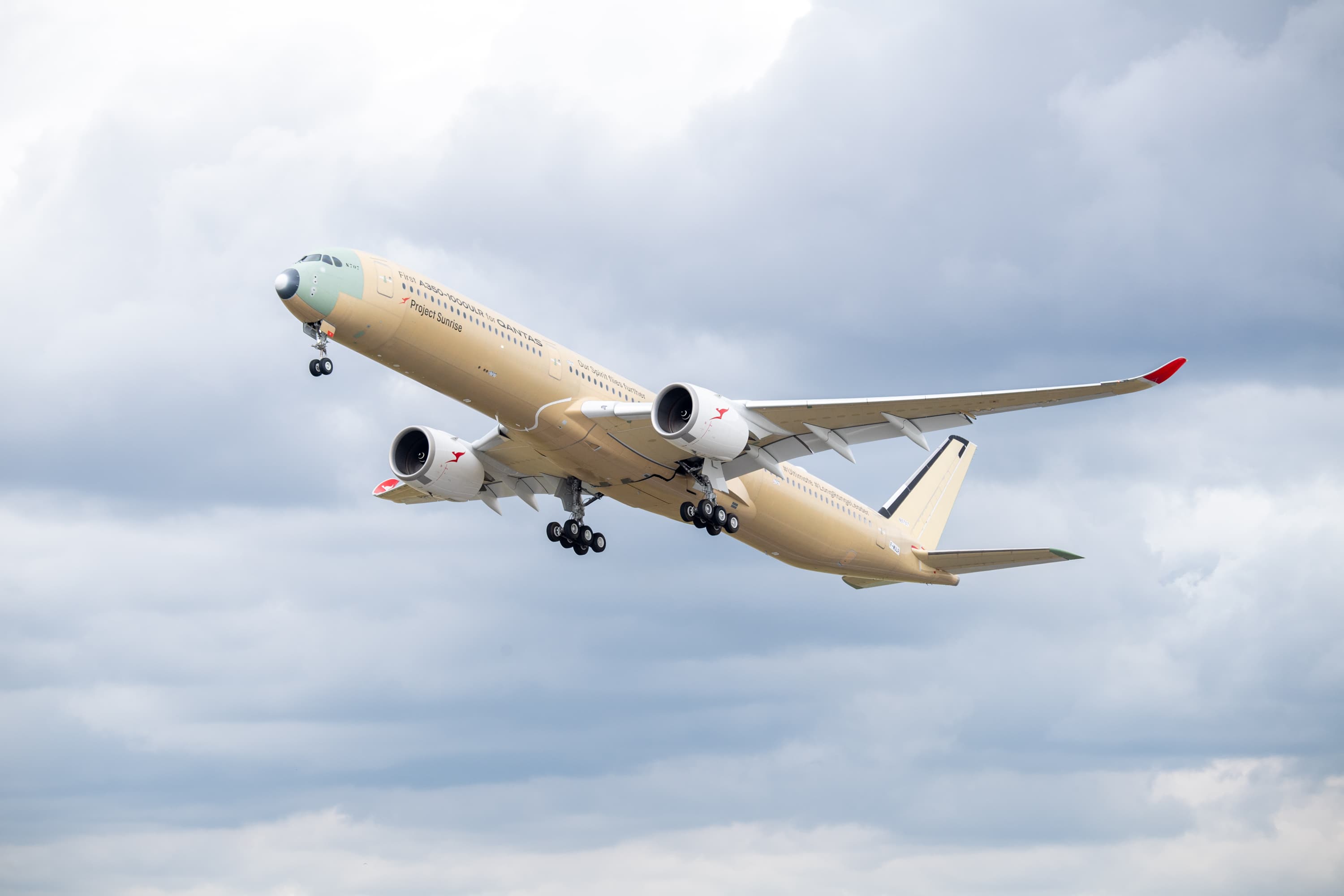
Photo: © Airbus SAS — first flight of MSN 707, June 2 2026
Today, June 2 2026, the first Airbus A350-1000ULR lifted off from Toulouse-Blagnac Airport for its maiden flight. MSN 707 — the first of 12 aircraft ordered by Qantas for Project Sunrise — flew for 3 hours and 43 minutes, reaching above 41,000 feet, and landed without incident.
It's a big deal. Let me explain why.
Nine Years in the Making
Project Sunrise was announced in 2017. The idea: make nonstop commercial flights from Sydney and Melbourne to London and New York not just possible, but commercially viable. Qantas challenged the aircraft manufacturers to solve the problem. Airbus stepped up with a heavily modified A350-1000 featuring an additional rear center fuel tank, pushing range close to 10,000 nautical miles — roughly 1,000nm more than the standard variant.
Boeing threw its hat in the ring too, with a proposed 777X derivative. Qantas picked Airbus in 2022. The right call, as it turns out, given where the 777X program currently stands — but more on that shortly.
The certification campaign now begins in earnest. Around 80 hours of flight testing lie ahead over approximately two months. Delivery to Qantas is currently scheduled for April 2027, with Sydney–London nonstop service planned for later that year.
It's been delayed before. But today, the plane actually flew. That matters.
22 Hours in Economy. Let That Sink In.
The A350-1000ULR will carry 238 passengers in four classes:
- 6 First suites
- 52 Business suites
- 40 Premium Economy seats
- 140 Economy seats
That last number is significant. When Singapore Airlines operates its A350-900ULR on the Singapore–New York route — currently the world's longest commercial flight at around 18 hours — there is no economy class. It's Business and Premium Economy only. The yield math simply didn't work for SQ at those distances.
Qantas is betting it does work at 22 hours. Economy seats will have 33 inches of pitch (slightly better than most long-haul economy), Bluetooth connectivity, and individual screens. The seat itself is… an economy seat. On a 22-hour flight.
As someone who has spent considerable time thinking about long-haul comfort, I'll say this: the cabin design matters enormously at these distances, and I'm curious — genuinely curious — why Qantas hasn't announced anything resembling Air New Zealand's Skycouach concept. The New Zealand carrier's economy cuddle seat, which converts a row of three into a flat-ish lounging surface, has been a quiet revolution for families and couples on long flights. On a 22-hour sector, it would be transformative.
Qantas has shown renders of their wellness zone, their lighting design, their business suites. Economy, so far, looks like economy. We'll see.
What It Means for Passengers
If you're in Business or First, these flights will be exceptional. Qantas has designed the Project Sunrise cabins from scratch specifically for ultra-long-haul, with serious attention to sleep, wellness, and circadian rhythm management.
If you're in Economy, you're doing 22 hours in a regular seat. You will want:
- Good noise-cancelling headphones
- An aisle seat or a window (never the middle)
- Melatonin and a plan
- Realistic expectations
The flip side: nonstop Sydney to London. No Abu Dhabi at 3am, no connection stress, no second security queue. For many passengers, that trade-off is absolutely worth it.
Meanwhile, in Everett, Washington...
The same week that the A350-1000ULR completes its maiden flight, the FAA Administrator has signaled that the Boeing 777X is unlikely to receive certification in 2026.
To be clear — these are different programmes, different challenges, different regulatory contexts. The A350-1000ULR is a derivative of a certified aircraft; the 777X is an entirely new type going through full certification. Comparing them directly isn't entirely fair.
But the optics are what they are. The 777X first flew in January 2020. It is now approaching seven years behind its original schedule and roughly $15 billion over budget. The FAA has indicated it will prioritise certifying the 737 MAX-7 and MAX-10 variants first, which pushes 777X certification into 2027 at the earliest.
Boeing maintains there are no new technical issues — the delay is process, not hardware. Having followed this programme for years, I'd say: the process is the issue. But that's a longer conversation.
For now: good day for Airbus. Another difficult week for Boeing.
The Bigger Picture
Ultra-long-haul flying is no longer a curiosity or an experiment. Singapore Airlines has proven the commercial model works at 18+ hours. Qantas is about to prove — or disprove — that it works at 22.
If Project Sunrise succeeds commercially, expect other carriers and manufacturers to follow. The question of where the absolute limit of practical non-stop range lies is genuinely open. The answer, for now, is somewhere past Sydney and just short of everywhere.
Today was a good day for aviation. The plane flew. After nine years, that's enough.
Sources: Simple Flying · FlightGlobal · Aviation A2Z · One Mile at a Time