The Next Leap in Flight: Status Check on the Technologies That Will Change How We Fly
Supersonic jets, flying taxis, wingless airliners, and an engine without a cowling — here's what each of these technologies actually is, the milestone to watch next, and a grounded read on when you might board one.

Photo: Joby Aviation
If you've spent any time around aviation, you'll know the shape of a commercial airliner has barely changed since the 707 — a tube, two wings, two underwing turbofans. Engines got quieter and more efficient, composites replaced aluminum, but the basic formula held for almost 70 years.
Right now, more genuinely disruptive aircraft programs are in active development simultaneously than at any point in decades — and they're not science projects anymore. Metal is being bent, wind tunnels are running, and one of them has already broken the sound barrier. These are massive engineering leaps, and none of them are happening on the timeline a press release would have you believe. But that's exactly what makes them worth following.
Here's what each one actually is, why it's exciting, the next milestone to watch for, and a grounded read on when you might actually fly on one.
Supersonic: Boom's Overture
 XB-1, Boom Supersonic's demonstrator aircraft — Image: Boom Supersonic
What it is: A clean-sheet supersonic airliner designed to cruise around Mach 1.7 — fast enough to cut New York–London to roughly 3.5 hours, about half of today's flight time.
Why it's exciting: This is the first serious attempt at a supersonic passenger jet since Concorde retired in 2003, and unlike Concorde, Boom is designing Overture to avoid the worst of the noise and economics that doomed its predecessor — including its own purpose-built engine, Symphony, developed because nothing on the market was suitable.
Next milestone: Boom's scaled demonstrator, the XB-1, already broke the sound barrier on January 28, 2025, and has flown supersonic multiple times since — that part is proven. The next big one is the full-scale Overture prototype rollout, planned for 2026, with Symphony engine testing also kicking off this year.
When you might fly it: Boom is targeting first flight of the full-scale aircraft in 2027 and certification around 2029–2030. United, American, and Japan Airlines all hold orders or options. Realistically, clean-sheet airframes and clean-sheet engines together is an enormous lift — independent analysts expect this to slip into the early-to-mid 2030s. Still: for the first time in 20 years, there's a real prototype to point to.
eVTOL Air Taxis: Joby, Archer, and Beta
What it is: Small, all-electric aircraft that take off and land vertically — no runway needed — designed to hop short distances (airport-to-downtown, suburb-to-suburb) quickly and quietly.
Why it's exciting: This isn't just a new aircraft, it's new infrastructure — vertiports, new air-traffic procedures, electric propulsion at commercial passenger scale. It's the closest thing on this list to genuinely new transportation, not just a faster or more efficient version of what exists.
Next milestone: Joby Aviation is the frontrunner, sitting at stage 4 of the FAA's five-stage certification process and having flown its first FAA-conforming Type Inspection Authorization aircraft in March 2026. Archer's "Means of Compliance" — the FAA-accepted blueprint for how it'll prove the aircraft is safe — was approved in January 2026, with testing now underway. Beta Technologies' ALIA-250 is progressing too, a bit further back.
When you might fly it: Here's the twist — the first paying passengers are likely to fly in Dubai, not the US. Joby has a six-year exclusivity deal for a vertiport at Dubai International Airport and expects commercial flights there in 2026, leveraging FAA data under a UAE certification path. US passenger service realistically isn't expected before mid-2027, and certification-framework lawsuits filed in May 2026 add some uncertainty even to that. Still — within the next 12–18 months, someone will be selling tickets on one of these.
Blended Wing Body: JetZero
 JetZero's blended wing body demonstrator concept — Image: JetZero
What it is: Instead of a cylindrical fuselage with wings attached, the entire aircraft is shaped as one continuous lifting surface — wide, flat, and blended. Think less "tube with wings," more "manta ray."
Why it's exciting: This is the most radical shape change on this list. A blended wing body isn't just more efficient — the cabin itself would be a fundamentally different space, wider and more open than any tube fuselage could be. JetZero claims up to 50% fuel savings versus a comparable conventional aircraft, with a more conservative 30% as the program's official target.
Next milestone: The US Air Force, NASA, the Defense Innovation Unit, and the Pentagon's Office of Strategic Capital are jointly funding a full-scale demonstrator, being built by Northrop Grumman's Scaled Composites in Mojave, California. Full-scale fabrication is happening through 2026, with ground testing starting in April 2027.
When you might fly it: First flight of the demonstrator is targeted for September 2027 — but this is a military-funded technology demonstrator, not a certified airliner program. History suggests a decade or more between "demonstrator flies" and "you board one," but this is the program that, if it works, changes what an airplane cabin looks like entirely.
A personal note: this is the one I'm most excited about. Blended wing body designs were a recurring subject during my aeronautical engineering master's — endless lectures on lift distribution, cabin pressurization on non-circular cross-sections, and why it's so hard to build. Seeing an actual full-scale demonstrator under construction, after years of it being purely an academic exercise, is genuinely thrilling.
Open Fan Engines: CFM's RISE Program
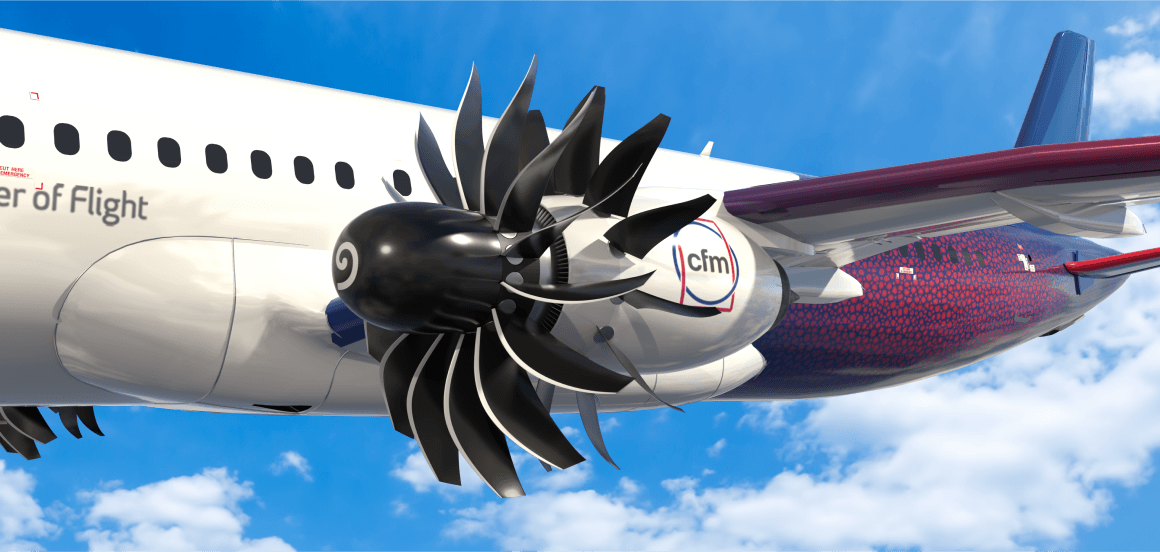 CFM RISE open fan engine concept — Image: CFM International (Safran / GE Aerospace)
What it is: A jet engine with no surrounding nacelle — the cowling that normally wraps around a turbofan — exposing larger, more efficient fan blades directly to the airflow. Think the efficiency of a turboprop with the speed of a jet.
Why it's exciting: This is the sleeper pick on this list, because it's not a new airframe — it's a new engine destined for the next narrowbody, the eventual successor to the A320 and 737. That means it could end up powering more aircraft, on more routes, than every other technology here combined. The target: 20%+ better fuel burn and CO2 than today's best engines.
Next milestone: CFM International (the GE Aerospace–Safran joint venture) has logged over 500 hours of wind tunnel testing in its "minimum body" campaign at ONERA and Airbus's Filton facility, with full aircraft model testing continuing through 2026. In February 2026, CFM, Airbus, and the Civil Aviation Authority of Singapore signed an agreement to explore real-world airport operational testing — the first step from lab to ramp.
When you might fly it: A flight-test engine is planned to fly on an A380 testbed out of Toulouse by the end of the decade. Open fan designs still need to prove themselves on noise and airport integration, but if CFM nails this, it's plausibly under your wing on a domestic flight sometime in the 2030s.
Two More on the Radar
 Airbus ZEROe hydrogen aircraft concept — Image: Airbus
Hydrogen-powered aircraft (Airbus ZEROe): A 100-seat aircraft powered by hydrogen fuel cells — zero emissions at the point of use. Airbus confirmed in early 2026 that the concept is technically feasible at an early readiness level (TRL 3). The honest update, though: in early 2025 Airbus pushed the whole program back 5–10 years, cut its budget by a quarter, and scrapped plans to flight-test fuel cells on an A380. Realistic entry into service is now the late 2040s — the limiting factor isn't the aircraft, it's the total absence of green hydrogen production and airport infrastructure at any scale.
 Heart Aerospace ES-30 in cruise flight — Image: Heart Aerospace
Hybrid-electric regional (Heart Aerospace ES-30): A 30-seat regional airliner offering 125 miles on pure electric power and 500 miles in hybrid mode — aimed at short regional routes currently flown by noisy, fuel-thirsty turboprops. The X1 demonstrator flew on electric power in 2025; the X2 is set for a hybrid-electric flight in 2026. Certification is targeted for 2029, entry into service 2031 — by the standards of this list, a refreshingly believable timeline.
The Cheat Sheet
| Technology | What It Is | Next Milestone | When You Might Fly It |
|---|---|---|---|
| Supersonic (Boom Overture) | Mach 1.7 airliner, NY–London in ~3.5 hrs | Full-scale prototype rollout, 2026 | ~2030s |
| eVTOL (Joby, Archer, Beta) | Electric vertical takeoff air taxis | Joby commercial launch in Dubai, 2026 | Dubai 2026; US ~2027+ |
| Blended Wing Body (JetZero) | Whole-aircraft lifting body, ~30-50% fuel savings | Full-scale fabrication through 2026, first flight Sept 2027 | Demonstrator only — commercial 2030s+ |
| Open Fan (CFM RISE) | Cowling-free engine for next-gen narrowbodies | Singapore real-world ops trials agreed | ~2030s, on the busiest routes |
| Hydrogen (Airbus ZEROe) | Fuel-cell powered 100-seat aircraft | Concept feasibility confirmed (TRL 3) | Late 2040s |
| Hybrid-electric (Heart ES-30) | 30-seat electric/hybrid regional aircraft | X2 hybrid-electric flight, 2026 | 2031 |
None of this changes what you're flying on next month — but for the first time in decades, there's a genuine, fundable, flying prototype behind almost every item on this list. That's the real story: not "is this real," but "how fast can these actually move."
While you wait, our FlightCheck Tools can help you find the most reliable routes and fairest fares on the aircraft flying today.